


-
Home Security Alarms in Sydney: Which System Is Right for Your Property?
Wired vs. Wireless Alarm Systems
When safeguarding your Sydney property, the foundational choice comes down to how your security components communicate: hardwired infrastructure or wireless frequencies.
Hardwired Security Systems
Wired systems rely on physical cables run through walls and ceilings to connect sensors directly to the main control panel.
- Pros: Exceptionally stable, immune to wireless frequency jamming, and requires no battery replacements for individual sensors.
- Cons: Higher initial installation labor costs and structurally invasive, making them better suited for new builds, major commercial developments, or large-scale strata and multi-dwelling projects.
Wireless Security Systems
Wireless configurations utilize secure radio frequencies (RF) to connect peripheral sensors to the central hub.
- Pros: Rapid, drill-free installation and completely modular, allowing you to easily take the system with you if you relocate. Perfect for heritage homes in the Eastern Suburbs or high-density spaces like Waterloo apartments and modern developments across Zetland.
- Cons: Sensors require battery replacements every few years, and extreme signal blockage can occur in buildings constructed with dense reinforced concrete.
Back-to-Base Monitoring vs. Self-Monitoring
Once your alarm triggers, who answers the call? Choosing your monitoring framework dictates how emergency responses are handled.
Monitoring Type
Operation Mode
Best For
Emergency Handling
Back-to-Base
Connected 24/7 to a professional, graded Security Monitoring Centre.
High-value assets, commercial spaces, and total peace of mind.
Automatically dispatches security patrols or emergency services if a threat is verified.
Self-Monitoring
Sends push notifications, alerts, or SMS directly to your smartphone via an app.
Budget-conscious homeowners and tech-savvy users.
Completely relies on you being awake, connected to mobile data, and ready to call Triple Zero (000) yourself.
💡 Not sure which one fits your budget? You can easily request a tailored security evaluation through our direct AntennaPros Contact Portal.
Essential Peripheral Sensors: Laying the Net
A robust alarm system relies on a combination of strategic sensors working together to secure your property’s geometric vulnerabilities.
- Motion Sensors (PIR): Passive Infrared detectors monitor changes in heat signatures within a room. Modern versions feature “pet immunity” calibrations to prevent false alarms from indoor pets up to a certain weight limit.
- Door/Window Reed Switches: Magnetic contacts placed on entry points. The moment the connection breaks (e.g., a window is forced open), the alarm triggers instantly before an intruder even steps inside.
- Glass Break Detectors: Specialized acoustic sensors tuned to the exact frequency of shattering glass. These provide an invaluable layer of perimeter defense for large glass bi-fold doors or ground-floor windows.
Elevating Security: Integration with CCTV and Access Control
Standalone alarms tell you when an intrusion occurs, but integrated systems give you absolute control and visual verification.
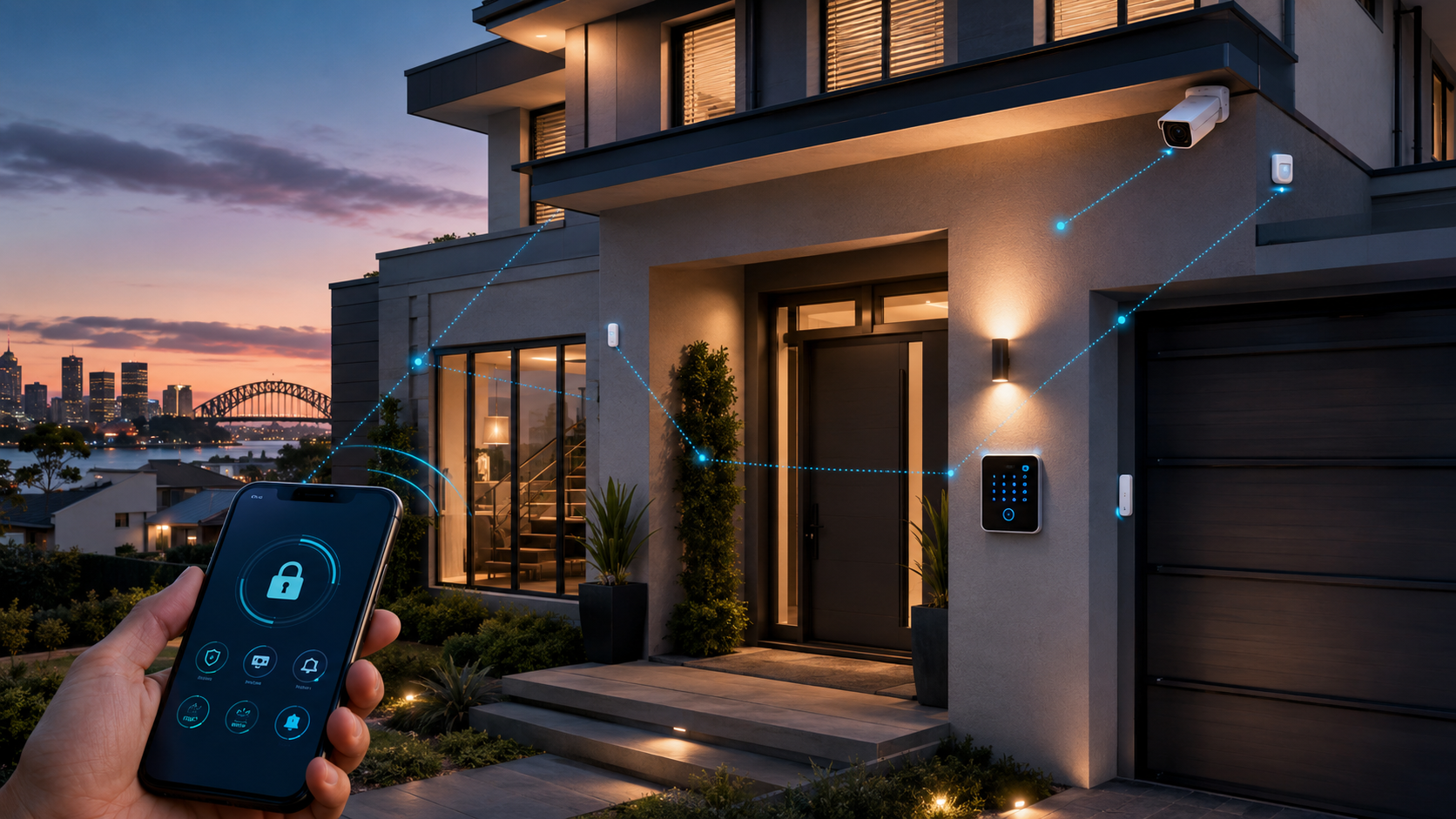
Combining your security alarm with modern high-definition security setups allows for instantaneous visual verification. When a perimeter zone is breached, your smart app can surface the exact video feed covering that zone, immediately distinguishing a true security event from a false alarm.
Furthermore, integrating advanced intercom systems or digital entry points ensures your alarm automatically disarms the moment an authorized person unlocks the door, minimizing user error and accidental activations.
NSW Compliance and Licensing Requirements
In New South Wales, residential and commercial security installation is heavily regulated to protect consumers and maintain industry integrity.
Important Compliance Check: Anyone who sells, advises on, installs, repairs, or maintains security equipment in NSW must be legally licensed by the Security Licensing & Enforcement Directorate (SLED) of the NSW Police Force.
- Individual Installers: Must hold a valid Class 2C Security Equipment Specialist licence. This guarantees they have undergone rigorous criminal history and probity background checks by the NSW Police Force to ensure they are fit and proper persons.
- Security Companies: Must hold a valid Master Security Licence, which must be clearly displayed on all premises, vehicles, and advertising documentation.
- Bylaw Tip: Unlicensed installations can void your home insurance policies and lead to hefty government fines. Always verify your installer’s credentials against the SLED public register before signing a contract.
Ready to secure your Sydney property with a compliant, future-proof system?
Navigating the maze of wired vs. wireless configurations, strict NSW SLED licensing laws, and the financial pitfalls of false alarm fines ($1,600 per police callout) is overwhelming—but you don’t have to do it alone. At AntennaPros, our licensed Class 2C Security Equipment Specialists take the guesswork out of home security by designing tailored solutions that align with your property’s unique architecture, whether you’re protecting a heritage terrace in Paddington, a high-rise unit in Zetland, or a commercial warehouse in Alexandria. We handle everything from seamless NBN cellular module upgrades (so you never lose connectivity during blackouts) to the precise calibration of pet-immune PIR sensors, ensuring 100% NSW compliance and zero false triggers. Take the first step toward total peace of mind today: Request your complimentary, no-obligation site assessment and custom security design by calling our Sydney team directly, or visit our AntennaPros Contact Portal to unlock exclusive package pricing tailored to your specific property layout.
Frequently Asked Questions
Do I legally need a licensed professional to install a security alarm in Sydney?
Yes. Under NSW law, anyone who installs, maintains, repairs, or provides advice on security equipment must hold a valid Class 2C Security Equipment Specialist licence issued by the NSW Police Force SLED. Attempting a DIY install on a system that is hardwired or professionally monitored can void your home insurance policy and violate local compliance regulations.
What is the financial penalty for a false alarm response by the NSW Police?
The NSW Police Force enforces strict penalties for false alarm callouts under the Police Act 1990 (Section 209). If emergency services or police patrols respond to a false alarm from a monitored security device, the penalty fee is $1,600. This makes professional calibration, regular maintenance, and visual verification via smart cameras essential to avoid heavy fines.
How long is a building intruder alarm legally allowed to sound in NSW?
According to the NSW Environment Protection Authority (EPA), a building intruder alarm must not audibly sound for more than 5 minutes (for systems installed after 1997). If an alarm sounds continuously or intermittently past the legal limit and disturbs neighbors, local councils and police can issue penalty notices starting at $300 for individuals and $600 for corporations.
Can I install a security system if I am renting an apartment or terrace in Sydney?
Absolutely. Modern wireless alarm systems are highly modular and entirely renter-friendly. They utilize drill-free, zero-penetration adhesive mounts for door contacts and motion sensors. This ensures your security infrastructure can be cleanly removed and relocated to a new property when your lease ends without violating your tenancy agreement or damaging strata walls—a perfect solution for apartments and units across Sydney.
How does the NBN rollout affect older landline-monitored alarms?
Traditional copper phone lines have been phased out across Australia. Legacy security alarms that relied on old dial-up landlines to report breaches will no longer work over the standard NBN during a power outage, as NBN boxes require local mains power. To future-proof your system, you must upgrade your alarm panel or adapt your property with a dedicated cellular module, which can be done alongside configuring new home data points to keep your connection seamless.
Will my household pets trigger modern motion sensors?
Not if the system is designed correctly. Modern security setups utilize specialized Pet-Immune PIR (Passive Infrared) motion sensors. These units are calibrated to ignore changes in heat signatures and motion generated by animals under a specific weight threshold (typically up to 25kg or 40kg). Our technicians map your home layout to position sensors away from “cat climbing zones” like couches or stairs.
Can installing a security alarm reduce my home insurance premiums in Sydney?
Yes. Most major Australian insurance providers offer discounted premiums—sometimes up to 10% to 15%—if your property is protected by a professionally installed, SLED-compliant security alarm system. The discount is often higher if your system includes 24/7 back-to-base monitoring, as it drastically reduces the statistical risk of successful theft.
Read Also: Digital TV Antenna Installation Cost in Sydney – The Ultimate 2025 Guide
Call AntennaPros Now: (02) 8710 4700
Website: antennapros.com.au
Service Areas: All Sydney suburbs—from Palm Beach to Penrith, Bondi to Bankstown.
Same-day emergency service available. Don’t leave your home, family, or business unprotected for another night.